If you’ve ever opened a brokerage app and watched the red and green numbers flash across your screen, you’ve probably asked yourself a very simple question: Why is that number going up? Why is it going down?
For beginners, the stock market can feel like a chaotic casino. You might assume that prices are just random guesses or that someone in a suit on Wall Street simply picks a number out of thin air.
The truth, however, is much more logical—and fascinating.
Understanding how stock prices are determined is the first step to becoming a confident, long-term investor. It moves you from guessing to learning, and from gambling to planning. In this guide, we’ll break down the mechanics of stock pricing in simple, human-friendly terms, helping you build a foundation of trust and knowledge about the U.S. stock market.
What Is a Stock Price? (A Simple Definition) How Stock Prices Are Determined
Let’s start with a clear definition that search engines and beginners alike will appreciate:
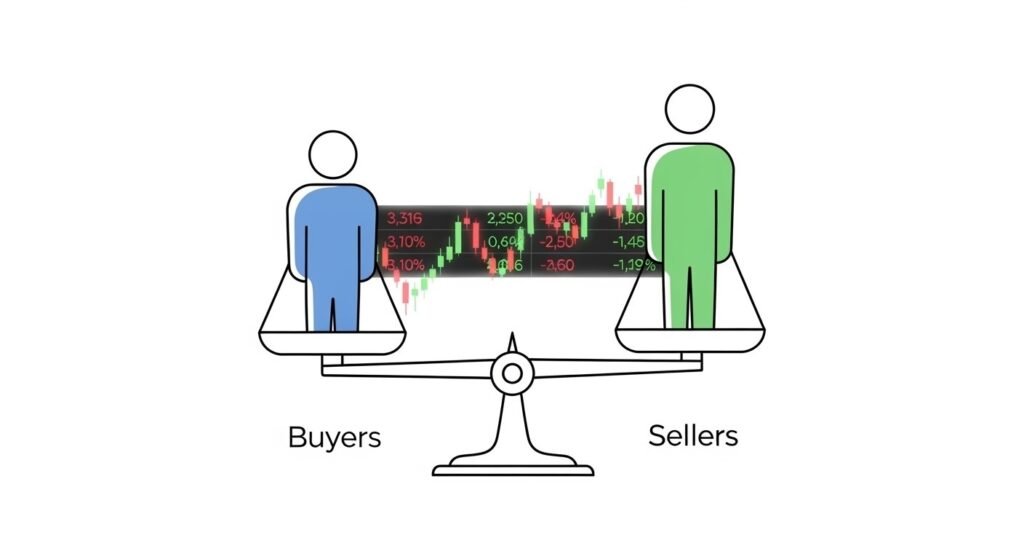
A stock price is the current price that someone is willing to pay to buy a share of a company, and that someone else is willing to accept to sell it. In technical terms, it is the point of agreement between the highest bidder (buyer) and the lowest seller at any given moment.
Think of it like a yard sale. If you are selling a used couch for $100, but no one is willing to pay more than $50, the “market price” of that couch is $50—regardless of what you think it’s worth. Stocks work the same way, just much, much faster.
The Engine of the Market: Supply and Demand
At its core, the stock market is driven by the simplest economic principle in the world: supply and demand.
- Supply: The number of shares available. (For most major U.S. companies, this number is fixed or slowly changing).
- Demand: How badly people want to buy those shares.
If more people want to buy a stock (demand) than sell it (supply), the price goes up. If more people want to sell a stock than buy it, the price goes down.
Real-World Example:
Imagine a popular new smartphone launches, and the company only made 1,000 units. If 10,000 people want to buy one, the price of that phone on the resale market will skyrocket. The same happens with stocks. If a company reports amazing earnings, suddenly millions of investors want a piece of it, pushing the price higher.

The Visible Mechanics: The Bid-Ask Spread
You won’t see a single “price” on the stock market. Instead, you see a constant negotiation happening between buyers and sellers. This happens through two key numbers:
- The Bid Price: The highest price a buyer is willing to pay for a stock right now.
- The Ask Price: The lowest price a seller is willing to accept for a stock right now.
The difference between these two is called the “spread.”
For popular U.S. stocks like Apple or Microsoft, the spread is often just a penny. This means the market is very “liquid”—it’s easy to buy or sell without moving the price too much. For smaller companies, the spread might be wider, making them more expensive to trade.
When you place a “market order” to buy a stock, you are agreeing to pay the current Ask price. When you sell, you get the current Bid price.
Primary Factors That Move Stock Prices
While supply and demand is the “how,” the real question for investors is “what creates demand?” Here are the primary factors that influence whether people want to buy or sell a U.S. stock.
1. Company Earnings and Fundamentals
This is the most important long-term driver. Every three months, public U.S. companies report their earnings. Investors look at:
- Revenue: Is the company selling more stuff?
- Profit Margins: Is it keeping more of the money it makes?
- Future Guidance: What does the company think will happen next quarter?
If a company beats expectations, demand usually rises. If they miss expectations, demand falls. This is why you see stocks jump or drop sharply on earnings report days.
2. Supply and Demand Dynamics (Stock Splits & Buybacks)
Companies can directly affect the supply side of the equation.
- Stock Buybacks: When a company uses its cash to buy its own shares, it reduces the supply of shares available to the public. With lower supply and steady demand, the price per share tends to increase.
- Stock Splits: If a company does a split (turning one $1,000 share into ten $100 shares), they increase supply but lower the individual price. This can attract more small investors, sometimes boosting demand.
3. The Broader Economy
Stocks don’t exist in a bubble. They are influenced by the health of the U.S. economy. Key indicators include:
- Interest Rates: Set by the Federal Reserve. When rates are low, borrowing is cheap, companies grow, and stocks often rise. When rates rise, borrowing costs increase, which can slow profits and lower stock prices.
- Inflation: High inflation can eat into consumer spending and company profits.
- Employment Data: If more people are working, more people are spending, which helps companies grow.
4. Industry and Sector Trends
Sometimes a stock moves simply because of what’s happening in its neighborhood. If oil prices spike, all energy stocks might rise, even if one specific oil company didn’t do anything new. If tech stocks are falling out of favor, a perfectly healthy software company might see its price dip simply because it’s in the “tech” category.
5. Market Sentiment and News
Humans are emotional. Fear and greed are powerful forces in the U.S. stock market.
- Fear: Bad news headlines, geopolitical events, or a market crash can cause mass selling (panic selling), driving prices down faster than fundamentals would suggest.
- Greed: Hype around a new technology (like Artificial Intelligence) can drive prices up as investors rush to be part of the next big thing.

A Beginner’s Guide to “Fair Price”
So, if prices bounce around based on news and emotion, how do you know if a stock is expensive or cheap? This is where valuation comes in. You don’t need to be a math whiz to understand the basics.
Investors look at metrics to see if the current price matches the company’s reality.
- P/E Ratio (Price-to-Earnings): This compares the stock price to the company’s profit.
- Simple Analogy: If a stock costs $100 and earns $5 per share, it has a P/E of 20. That means you are paying $20 for every $1 of earnings. If another similar stock has a P/E of 10, the first one might be “overvalued” (expensive) compared to the second.
- Market Cap: This is the total value of the company (Price x Total Shares). It tells you how big the company is compared to others.
Understanding these metrics helps you make decisions based on value, not just hype. How Stock Prices Are Determined
Risk Awareness: Volatility and Emotion
As we build a trustworthy resource at HowInvests.com, it’s vital to discuss risk.
Stock prices do not move in a straight line up. They are volatile. A stock can drop 10% in a week even if the company is fundamentally sound. This happens because:
- Algorithms are trading millions of shares per second. How Stock Prices Are Determined
- Institutional investors are rebalancing their massive portfolios. How Stock Prices Are Determined
- Retail investors (like us) react to scary news headlines. How Stock Prices Are Determined
Important Reminder: Never invest money you need in the next 3–5 years. The stock market is not a savings account. It is a long-term tool for building wealth, but you must be prepared for the psychological ups and downs.

Common Misconceptions About Stock Prices How Stock Prices Are Determined
Let’s clear up some confusion that holds beginners back:
- Misconception: “A low-priced stock ($5) is cheaper than a high-priced stock ($500).”
- Reality: Price alone doesn’t indicate value. A $5 stock could be in a terrible company that is about to go bankrupt, while a $500 stock could be a growing giant. You must look at the company’s size and value, not just the share price.
- Misconception: “The price is based on the company’s past success.”
- Reality: The stock price is a forward-looking mechanism. It reflects what investors think the company will do in the future. That’s why a company with great past results can drop if they say next year will be tough.
- Misconception: “Someone is manipulating the price to take my money.”
- Reality: While “pump and dump” schemes exist in small, obscure stocks, the prices of major U.S. stocks (like those in the S&P 500) are determined by millions of buyers and sellers globally. It is the most fair and transparent pricing mechanism in the world.
Best Practices for Beginners: Price vs. Value How Stock Prices Are Determined
So, how should you, as a new investor, use this information? The key is to shift your mindset from price to value.
- Don’t Chase Hype: If a stock has gone up 50% in a month based on a Reddit post or a tweet, the price is likely detached from the company’s actual value.
- Focus on the Long Term: In the short term, prices are a voting machine (driven by popularity). In the long term, they are a weighing machine (driven by actual profits). Focus on the weight.
- Diversify: Because you cannot predict which individual stock prices will rise or fall, buy a basket of them. In the U.S., this often means buying an S&P 500 index fund. This lets you own a tiny piece of 500 companies, ensuring you don’t lose everything if one stock price plummets.
Frequently Asked Questions How Stock Prices Are Determined
1. Who actually sets the stock price?
No single person sets it. The price is determined by the collective actions of millions of investors worldwide. It is the “market clearing price”—the point where the number of shares buyers want equals the number of shares sellers want.
2. Why do stock prices change so fast during the day?
Because new information is hitting the market constantly. News breaks, algorithms update, and investors change their minds. Every time a new buyer and seller agree on a trade, the price updates to reflect that new agreement.
3. Is it better to buy when the price is low or high?
You generally want to buy when the price is low relative to the company’s value. This is called “buying with a margin of safety.” It is less about the numerical value of the price, and more about whether you are getting a good deal for the business you are buying.
4. Can a stock price go to zero?
Yes. If a company goes bankrupt, its stock becomes worthless. This is a key risk of owning individual stocks. However, if you own a diversified fund (like an index fund), it is highly unlikely to go to zero because it holds many different companies.
Conclusion How Stock Prices Are Determined
Learning how stock prices are determined removes much of the mystery and anxiety from investing. It’s not magic; it’s economics, human emotion, and math all happening in real-time.
As you begin your investment journey here in the U.S., remember to focus on the long-term value of the businesses you own, rather than the daily noise of price fluctuations. Use tools like the P/E ratio to gauge value, stay aware of economic trends like interest rates, and always keep your personal financial goals in mind.
The price tag on a stock is just the starting point of a conversation. Your job is to decide if the conversation is worth joining. Happy investing from the team at HowInvests.com!
Disclaimer: This article is for educational and informational purposes only and does not constitute financial advice. Always conduct your own research or consult with a qualified financial professional before making investment decisions.
Table of Contents How Stock Prices Are Determined

Stock Market Myths Beginners Still Believe Easy (Explained)
Many Americans want to start investing but hesitate because of things they’ve heard about the stock market. Some believe you […]
How Stock Prices Are Determined: What Moves the Market?
If you’ve ever opened a brokerage app and watched the red and green numbers flash across your screen, you’ve probably […]

Stock Market Crashes: What Happens & What to Do (Guide)
The news alerts start buzzing. Market Crash? Your phone pings with headlines screaming, “Dow Plummets 500 Points!” or “Markets in […]
How to Research a Stock Before Investing: 1 Beginner’s Guide
You’ve finally decided to take control of your financial future. You open an investment app, browse through a list of […]
Easy Learn Difference Between Stocks and Shares
So, you’ve finally decided to take control of your financial future. You’re reading the news, scrolling through finance blogs, and […]
What Is the Nasdaq Index? Easy Beginner Explanation
You’ve finally decided to take control of your financial future. You open a news app or a finance website, and […]

Investment Return Calculator USA | Project Your Wealth
Investment Return Calculator | Professional Financial Tool Investment Return Calculator USA Project your wealth — consistent returns, compound growth 💰 […]
What Is the New York Stock Exchange and How Does It Work?
Engaging Introduction Investing is a fundamental aspect of personal finance, enabling individuals to grow their wealth and secure their financial […]
How the US Stock Market Works Explained Easy
Have you ever heard a news anchor say, “The Dow jumped 500 points today,” and wondered what it actually means? […]
What Age Should You Start Investing? Easy
You’re finally ready to take control of your financial future. You’ve read the headlines about the stock market, heard coworkers […]