You’ve finally decided to take control of your financial future. You open a news app or a finance website, and you are immediately bombarded with headlines: “Nasdaq Index plunges 2% amid tech sell-off,” or “Nasdaq hits new all-time high.”
If you are new to investing, this can feel overwhelming. You might be asking yourself: What is this “Nasdaq Index” everyone keeps talking about? Is it a stock? Is it a company? Why does it move up and down?
You are not alone. Understanding the stock market starts with understanding its main players. Just as you need to know the difference between a savings account and a 401(k) to manage your personal finances, you need to understand market indexes to make sense of investing.
This guide will explain the Nasdaq in the simplest terms possible. By the end, you’ll understand what it is, why it matters to your money, and how it fits into your long-term financial goals.
What Is the Nasdaq Index? (The Simple Definition)
Let’s start with a clear, straightforward definition.
The Nasdaq Index (specifically the Nasdaq Index-100) is a “basket” of the 100 largest non-financial companies listed on the Nasdaq stock exchange. Think of it less like a single stock and more like a shopping cart filled with the biggest names in technology and growth industries.
When you hear on the news that “the Nasdaq Index is up today,” it means that, on average, the stock prices of these 100 giant companies are rising. It is a snapshot of how a specific slice of the American economy is performing.
It is important to note that most people refer to the Nasdaq-100 (NDX) when they say “the Nasdaq.” There is also the Nasdaq Composite, which includes over 3,000 stocks, but the Nasdaq-100 is the benchmark most frequently cited in financial media.
Nasdaq Index vs. NYSE: A Quick American Context
To understand the Nasdaq, you need to understand where stocks live. In the U.S., there are two primary stock marketplaces:
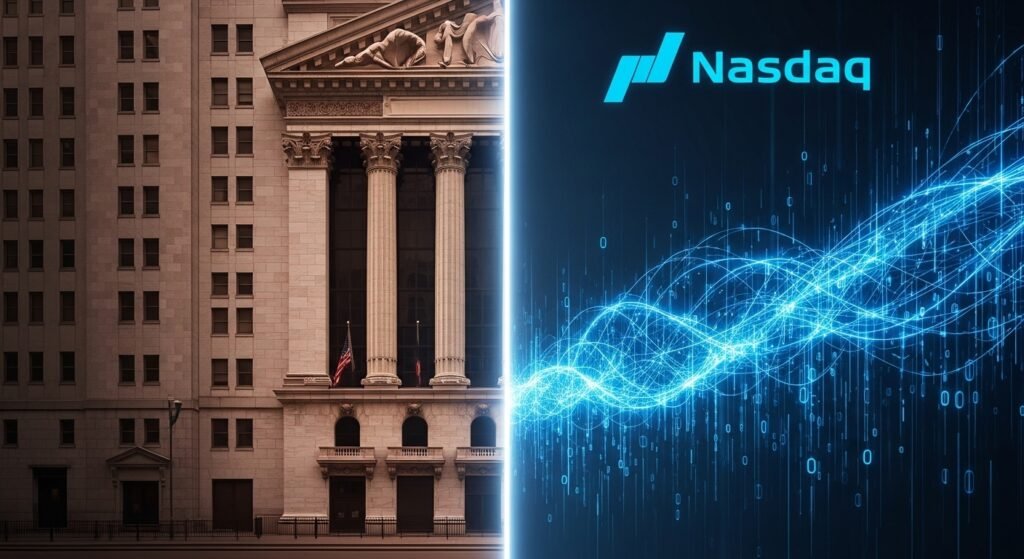
- The New York Stock Exchange (NYSE): This is the older, traditional exchange. Think of it as a physical floor with people shouting and waving papers (though it’s mostly digital now). It hosts many industrial and blue-chip companies.
- The Nasdaq: This is the first-ever electronic stock market. There is no physical trading floor. It was founded in 1971 and became the home for forward-thinking, tech-oriented companies.
Because the Nasdaq was a digital exchange from the start, it attracted the kind of companies that would define the digital age.
The “Tech-Heavy” Nasdaq Index: What’s Actually in the Basket?

The Nasdaq-100 is famous for being “tech-heavy.” If you use a smartphone, surf the internet, or stream movies, you are using the products of companies found in this index.
While it includes some companies from other sectors like consumer services and healthcare, the largest weights are given to the technology and communications sectors.
Real-World Example:
Imagine you build a basket of the most influential companies in the modern American economy.
- You put in the company that makes your iPhone (Apple).
- You put in the search engine you use every day (Google, or Alphabet).
- You put in the streaming service you watch tonight (Netflix).
- You put in the online store where you buy gifts (Amazon).
- You put in the social media app you scroll through (Meta).
That basket is essentially the Nasdaq-100. It represents the stocks that drive our digital lives. It is important to remember that it excludes financial companies (like banks), which is a key difference from other major indexes like the S&P 500.
Why Should a Beginner Investor Care About the Nasdaq Index?
As a beginner in the U.S., you might wonder, “Why does this matter for my 401(k) or my Roth IRA?” The answer is that the Nasdaq is a powerful indicator of market sentiment and economic trends.
1. It’s a Barometer for Growth Nasdaq Index
The Nasdaq Index is considered a “risk-on” barometer. When investors are optimistic about the economy, they tend to invest more in the growth-oriented tech companies found in the Nasdaq Index. When the Nasdaq Index is rising, it often signals that investors are confident about the future.
2. It Influences Your Investments
Even if you don’t own individual stocks, you likely own the Nasdaq. Many popular index funds and Exchange-Traded Funds (ETFs) track the Nasdaq-100.
- Example: The Invesco QQQ ETF (often just called “the Q’s”) is a fund designed to mirror the performance of the Nasdaq-100. If you own this in your brokerage account or retirement plan, you own a piece of all those 100 companies.
3. It Highlights Market Leaders
The Nasdaq is where many of America’s largest and most innovative companies live. By watching the Nasdaq, you get a sense of how the “big players” are performing, which often sets the tone for the rest of the market.
How to “Read” the Nasdaq Index Numbers
When you look at a chart for the Nasdaq, you are looking at a number that represents the total value of its 100 components.
- If the number goes up: The combined market value of the stocks in the index is increasing. More money is flowing into these stocks than out.
- If the number goes down: The combined market value is decreasing. Investors are selling these stocks, often to move money into safer assets like bonds.
A Simple Analogy:
Think of the Nasdaq like the average score of a basketball team’s starting lineup. If the “Nasdaq score” is high, it means the star players (Apple, Microsoft, etc.) are having a great game. If the score is low, the stars are struggling. You watch the team score to know how the game is going, just like you watch the Nasdaq to know how the tech sector is going.

Practical Guidance: How Beginners Can Approach the Nasdaq
If you are interested in gaining exposure to the types of companies found in the Nasdaq, here is the safest, most beginner-friendly way to think about it.
The Index Fund Approach
For most people aged 20–45, buying individual tech stocks is risky. A single bad product launch or earnings report can wipe out a significant portion of your investment.
Instead, consider the “buy the whole basket” approach.
- What to look for: An ETF that tracks the Nasdaq-100.
- Why it works: It gives you instant diversification. Instead of betting on whether Apple or Google will perform better, you bet on the entire sector’s growth.
- How to buy it: You can purchase shares of a Nasdaq-tracking ETF in any standard brokerage account, just like you would buy a stock. You can also often find these funds as options within your 401(k) plan.
Risk Awareness: The Volatility Reality (Important!)
This is a crucial section for building trust and protecting your capital. The Nasdaq is not the place for your emergency fund or money you need in the next year.
The Nasdaq is volatile.
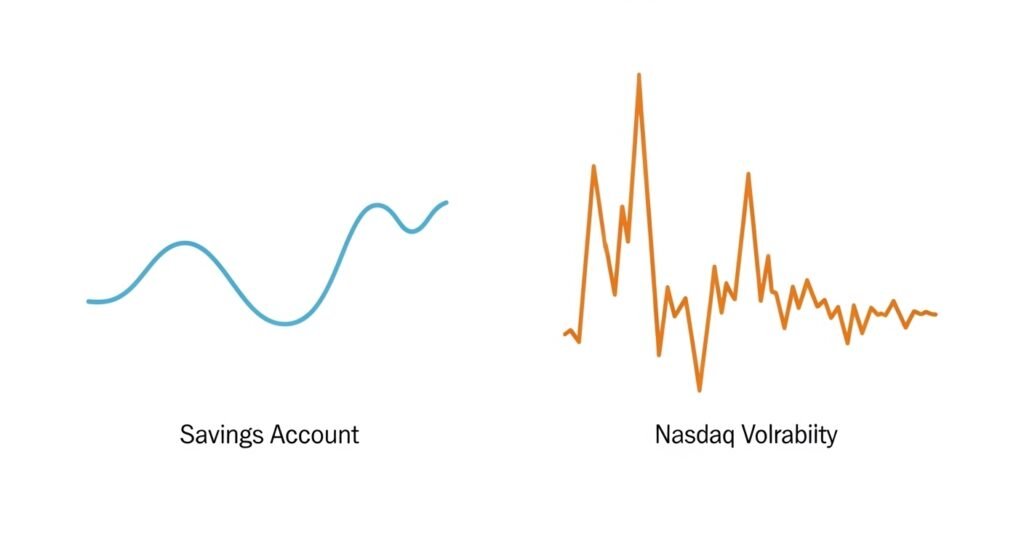
Because it is packed with growth stocks, it experiences dramatic swings.
- The Upside: During a bull market (like the tech boom of the late 2010s), the Nasdaq can soar higher than other indexes, leading to substantial growth.
- The Downside: During a market correction or bear market, the Nasdaq often falls harder and faster than more conservative indexes.
Example:
In 2022, while the broader market struggled, the Nasdaq entered a bear market, dropping significantly as interest rates rose. Tech companies, which rely on borrowing money to fuel future growth, are more sensitive to interest rate hikes set by the U.S. Federal Reserve.
Key Takeaway: Do not panic when you see the Nasdaq drop sharply. Volatility is a feature of this index, not a bug. If you have a long time horizon (5+ years), short-term drops are just noise in the system.
Common Beginner Mistakes to Avoid
When learning about the Nasdaq, it’s easy to fall into traps. Here are three to watch out for:
1. Confusing the Exchange with the Index
This is the most common point of confusion.
- The Nasdaq Exchange is the marketplace where stocks are bought and sold (like a shopping mall).
- The Nasdaq Index is a list of specific stocks within that mall.
Just because a stock is listed on the Nasdaq exchange does not mean it is in the Nasdaq-100 Index.
2. Chasing Past Performance
You will see charts showing the Nasdaq returned 30% in a single year. It is human nature to want that. However, past performance does not guarantee future results. Buying an index after it has already had a massive run-up can lead to disappointing returns if a downturn follows.
3. Ignoring Valuation
Just because a company is in the Nasdaq doesn’t mean it’s a good buy at any price. In the late 90s, the Nasdaq was filled with companies that had no profits, leading to the “Dot-Com Bubble.” When the bubble burst, the index lost a huge percentage of its value. Always keep an eye on valuations.
The Long-Term Perspective
For the U.S. beginner investor, the Nasdaq represents the power of innovation. Despite its ups and downs, the Nasdaq has been one of the best-performing major indexes over the long term. This is driven by the relentless growth of technology and its integration into every part of our lives.
If you are investing for retirement via a Roth IRA or a 401(k), having exposure to the Nasdaq (through a diversified fund) can be a great way to capture long-term economic growth. The key is to stay consistent—investing a fixed amount each month, regardless of whether the index is up or down (a strategy known as dollar-cost averaging).
Conclusion
The Nasdaq Index is more than just a number on a screen. It is a reflection of America’s largest and most dynamic tech-driven companies. For beginners, it serves as both a useful barometer for the economy and a potential opportunity for long-term growth.
Remember these core points:
- It is a basket of 100 leading non-financial stocks.
- It is heavily weighted toward technology.
- It is volatile—it will have big ups and big downs.
- You can invest in it safely using low-cost index funds or ETFs.
By understanding the Nasdaq, you are no longer just hearing noise on the news. You are understanding the language of the market.
Frequently Asked Questions (FAQ)
1. Is the Nasdaq the same as the S&P 500?
No. The S&P 500 includes 500 of the largest U.S. companies across all sectors, including banks, healthcare, and energy. The Nasdaq-100 focuses specifically on the 100 largest non-financial companies on the Nasdaq exchange, giving it a much heavier concentration in technology. The S&P 500 is broader; the Nasdaq is more tech-focused.
2. Can I lose all my money investing in the Nasdaq?
It is highly unlikely you would lose all your money. The Nasdaq is an index of 100 different companies. For the index to go to zero, every single major tech company in America would have to go bankrupt at the same time. However, you can lose a significant portion of your investment (20%, 30%, or more) during a bear market, which is why a long-term perspective is essential.
3. How is the Nasdaq different from the Dow Jones?
The Dow Jones Industrial Average is a price-weighted index of just 30 major U.S. companies. It is often seen as a measure of the “old economy.” The Nasdaq is much larger (100 companies) and market-cap-weighted (companies are weighted by their total size, not their stock price), making it a more accurate reflection of the modern tech-driven economy.
4. Do I have to pay capital gains tax if I sell a Nasdaq ETF?
Yes, if you hold the ETF in a taxable brokerage account and sell it for a profit, you will likely trigger a capital gains tax event. In the U.S., the rate you pay depends on how long you held the investment (short-term vs. long-term). However, if you hold a Nasdaq-tracking ETF inside a tax-advantaged retirement account like a Roth IRA or Traditional 401(k), you can avoid or defer these taxes.
Table of Contents

What Happens to Stocks During a Market Crashs?
Let’s be honest: turning on the news and hearing that the stock market crashs is “plunging” or “in the red” […]
Market Volatility Explained: Easy steps & Why It Matters
If you’ve just started checking your investment app or your 401(k) balance, you might have noticed that some days the […]
Stock Market Myths Beginners Still Believe Easy (Explained)
Many Americans want to start investing but hesitate because of things they’ve heard about the stock market. Some believe you […]
How Stock Prices Are Determined: What Moves the Market?
If you’ve ever opened a brokerage app and watched the red and green numbers flash across your screen, you’ve probably […]

Stock Market Crashes: What Happens & What to Do (Guide)
The news alerts start buzzing. Market Crash? Your phone pings with headlines screaming, “Dow Plummets 500 Points!” or “Markets in […]
How to Research a Stock Before Investing: 1 Beginner’s Guide
You’ve finally decided to take control of your financial future. You open an investment app, browse through a list of […]
Easy Learn Difference Between Stocks and Shares
So, you’ve finally decided to take control of your financial future. You’re reading the news, scrolling through finance blogs, and […]
What Is the Nasdaq Index? Easy Beginner Explanation
You’ve finally decided to take control of your financial future. You open a news app or a finance website, and […]

Investment Return Calculator USA | Project Your Wealth
Investment Return Calculator | Professional Financial Tool Investment Return Calculator USA Project your wealth — consistent returns, compound growth 💰 […]
What Is the New York Stock Exchange and How Does It Work?
Engaging Introduction Investing is a fundamental aspect of personal finance, enabling individuals to grow their wealth and secure their financial […]