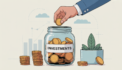
financial freedom plan
Have you ever stared at your alarm clock and wondered how many more mornings you’ll be forced to wake up to its jarring buzz? For most Americans, retirement feels like a distant dream—something that happens at 65 or later, after decades of the same routine. But what if I told you that you could radically compress that timeline? What if, with a focused strategy, you could reach a point in just five years where work becomes optional?
Introduction: financial freedom plan Is Early Retirement Really Possible in 5 Years?
Welcome to the 2-3-5 Freedom Blueprint—a mathematical, disciplined approach to building wealth that doesn’t rely on luck, lottery tickets, or complex stock-picking. This isn’t another “get rich quick” scheme. It’s a strategic framework designed around the explosive power of compound interest, behavioral consistency, and time. Whether you’re starting from zero or already have a small nest egg, this plan provides a clear roadmap to financial independence.
In this guide, we’ll break down each phase of the blueprint, reveal the psychological pitfalls that derail most people, and give you actionable steps to launch your own 5-year countdown to freedom.
Why the Traditional Retirement Mindset Keeps You Stuck
Most people approach wealth-building with a linear mindset: work hard, save a little, and hope Social Security and a 401(k) will be enough after 40 years. This passive approach has several fatal flaws:
financial freedom plan insurens
- It relies on decades of market timing without acknowledging that most investment growth happens in concentrated bursts.
- It underestimates the psychological toll of delaying gratification for 30-40 years.
- It ignores the power of front-loaded effort—where consistent early action creates disproportionately large results later.
financial freedom plan Stop Buying These 7 Things If You Want to Be Rich
The 2-3-5 Blueprint flips this script. Instead of spreading your effort over 40 years, you concentrate your discipline into a focused 5-year sprint. The goal isn’t to save millions in half a decade, but to build a self-sustaining financial engine whose growth eventually outpaces your living expenses.
Phase 1: The 2-Year Foundation – Surviving the Invisible Years

Keyword Focus: building wealth foundation, compound interest basics, disciplined investing
The first 24 months of this journey are what I call The Awakening. This phase has little to do with spectacular returns and everything to do with building unshakeable habits. You’ll commit to a consistent monthly investment into a diversified, low-cost index fund or ETF—something simple like an S&P 500 index fund.
During these foundation years, something frustrating happens: your account balance seems to move at a glacial pace. You might invest $300 monthly and see only modest gains. This is the test. Compound interest doesn’t reward you immediately; it tests your patience. Most people quit here, believing the process “doesn’t work.”
But around the 18–24 month mark, a subtle shift occurs. Your initial profits begin generating their own profits. The curve of your growth starts bending upward. You transition from hoping compound interest works to knowing it works. This mental shift is more valuable than any dollar amount—it turns you from a saver into an investor.
Action Step: Choose an amount you can invest monthly without strain ($50–$500). Open a brokerage account with a provider like Vanguard, Fidelity, or Charles Schwab. Set up automatic investments into a broad-market index fund. Do not check the balance daily. Your only job is to not interrupt the process.
Phase 2: The 3-Year Acceleration – Where Momentum Takes Over

Keyword Focus: investment acceleration, compounding returns, wealth momentum
Years three through five are the Acceleration Phase. This is where the financial flywheel you’ve been pushing starts spinning on its own. You’re still contributing monthly, but now your existing earnings are recruiting new “workers” (compound returns) that work alongside your contributions.
Here’s the powerful shift: you’ll likely reach a point where your portfolio’s growth over 12 months exceeds the total amount you deposited that year. Your money is officially outrunning your effort.
This is where most people self-sabotage. Seeing a balance of $15,000–$30,000 feels real—and scary. The temptation to cash out for a car, vacation, or to “lock in gains” becomes intense. Resisting this urge is critical. Cashing out now is like turning off a jet engine at takeoff. You’ve burned the fuel (your early discipline) but never get airborne.
Action Step: In this phase, focus on increasing your contributions whenever your income rises. Reinvest all dividends automatically. Protect your portfolio from lifestyle inflation. Your mindset should shift from “pushing the boulder” to “steering the momentum.”
Phase 3: The 5-Year Explosion – Reaching Critical Mass
Keyword Focus: financial independence, passive income, early retirement strategy
The Explosion Phase (year five and beyond) is where the mathematics of compounding become visually dramatic. Your portfolio hits a critical mass where its growth can equal or exceed your annual living expenses. This is your Freedom Number—not an arbitrary net worth, but the point where your investments generate enough passive income to cover your lifestyle.
For example, if your annual expenses are $40,000, and your portfolio yields a conservative 4% in dividends and growth, you’d need $1,000,000 to be completely free. However, the goal of the 5-year mark isn’t necessarily to be completely done, but to have your portfolio growing at such a rate that your path to that number is inevitable and rapid.
At this stage, your monthly portfolio growth might match a week’s salary. Then, eventually, a month’s salary. The psychological freedom this provides is profound: bills become trivial, job loss becomes an inconvenience, and your time becomes truly your own.
financial freedom plan book

Action Step: Calculate your Freedom Number (Annual Expenses ÷ 0.04). Use a compound interest calculator to project how your current plan will get you there. Focus on lowering expenses to reduce your target number.
The #1 Enemy of This financial freedom plan (It’s Not the Market)
Keyword Focus: behavioral finance, investing psychology, consistency over intensity
Volatility isn’t your enemy—it’s the entry fee for long-term growth. Your real adversary is your own psychology. The four classic ways people sabotage the 2-3-5 Blueprint are:
- Quitting during the invisible years because results seem too slow.
- Cashing out during acceleration to fund lifestyle purchases.
- Chasing “hot” investments and abandoning the boring index fund strategy.
- Stopping contributions during market dips or personal financial setbacks.
The solution is automation and emotional detachment. Automate your investments completely. Write down your “Explosion Date” five years from today. Judge your progress only on that date, not during temporary market downturns.
Your Step-by-Step Launch Checklist
Keyword Focus: how to start investing, automated investing setup, financial planning for beginners
- Determine Your Monthly Investment: Start with a realistic amount ($100–$500).
- Open a Tax-Advantaged Account: Consider a Roth IRA for tax-free growth if you qualify.
- Choose Your Investment Vehicle: A total stock market index fund (like VTI or FSKAX) is ideal for most.
- Set Up Automation: Schedule automatic transfers for the day after payday.
- Commit to a 5-Year Horizon: Mark your calendar and vow not to judge or alter the plan until then.
- Educate Yourself Continuously: Read books on investing psychology (The Psychology of Money is excellent) to strengthen your mindset.
Common Questions About the 2-3-5 Blueprint
Keyword Focus: early retirement FAQ, compound interest questions, investing for beginners
Q: Can this work with a low income?
A: Yes. Consistency matters more than contribution size. Starting early with less beats starting late with more.
Q: What if the market crashes during my 5 years?
A: This is actually an advantage. You’ll be buying shares at a discount during your accumulation phase. The key is to never stop contributing.
Q: Is 9% a realistic average return?
A: Historically, the S&P 500 has averaged about 10% annually before inflation. Using 7–9% for projections is conservative. Always model different scenarios.
Q: Do I need to pick individual stocks?
A: Absolutely not. In fact, individual stock picking usually reduces returns for most investors. Low-cost index funds are the preferred vehicle for this blueprint.
Conclusion: Your 5-Year Countdown Starts Now
Keyword Focus: financial freedom plan, take action today, wealth building strategy
The mathematics of wealth are simple, but not easy. The 2-3-5 Freedom Blueprint works not because it’s secret or complex, but because it aligns timeless principles—compound interest, behavioral consistency, and patience—into a focused, actionable plan.
Five years will pass regardless of what you do. The question is: where do you want to be when you arrive? Still wishing for freedom, or actively living it? The most powerful investment you can make today isn’t in a stock or fund—it’s in the decision to start.
Your freedom countdown begins with a single, automated transfer. Set it up this week. Future you will look back at this moment as the turning point.
Pingback: The Ultimate Guide to $0 Start Investing: Build Long-Term Wealth