
I used to think retirement was simple math. You save. You stop working. Then you spend what you saved until it runs out. That feels logical, right? Like filling a bathtub and then pulling the drain plug. So Retirement Spending Gap Video is Here
But here’s the thing. That’s not what actually happens for a lot of people.

There was this study that tracked retirees for twenty years. And what they found surprised me. A significant number of people who retired in their mid-sixties ended up with more money a decade later than they had on day one of retirement.
Not because they went back to work. Not because they made some brilliant stock market bet. Their net worth just quietly grew while they were living normal lives.
I read that and thought, wait, how?
If you’re not adding money to the account, how does the balance go up? That seems to break basic arithmetic.
The answer isn’t magic. It’s not some secret Wall Street strategy. It comes down to a piece of math that almost nobody runs before they retire. And once you see it, it changes the way you think about whether you’re actually on track or not.
What Most People Get Wrong Retirement Spending Gap
Let me give you an example that makes this concrete.
Say you have two people. Both are sixty-five. Both just retired. John has one point three million dollars saved. He’s careful with his money, maybe too careful. Every time he spends a dollar, he feels like that’s one less dollar he’ll have in ten years. So he holds back. He watches the balance nervously.
Linda has one point one million. A little less. But she also has a small pension and Social Security coming.
Fast forward ten years. John has one point nine million. Linda has one point seven million. Both have more than the day they quit working.
How?
The difference comes down to something I’d call the real spending gap. Not your portfolio size. Not your withdrawal rate. The gap between what you actually need to cover after Social Security, after taxes change, after certain costs disappear, and what your savings actually have to provide.
That number is almost always smaller than people assume.
Three Things That Shift When You Stop Working
Nobody told me this, so I’ll tell you. When you retire, three things change at the same time. And most people only think about one of them.
The first is that your spending often drops. Not because you’re eating cat food or canceling Netflix. It drops because a whole category of costs just vanishes. Think about it. Commuting. Work clothes. Dry cleaning. Buying lunch because you forgot to pack something. Payroll taxes, which if you’re an employee take seven point six five percent right off the top of every paycheck. Gone the moment you stop working. Also the money you were sending to your 401k every month? That stops being an outflow.
I’ve seen this happen with real people. Before retirement, they’re spending eighty-five thousand a year. After retirement, same house, same vacations, same lifestyle, it drops to sixty-two thousand. That wasn’t sacrifice. That was just work-related costs disappearing.
Run that math. If your spending falls from eighty thousand to sixty thousand, your portfolio doesn’t need to cover eighty thousand anymore. It needs to cover sixty thousand. That’s a twenty-five percent smaller gap before you’ve accounted for anything else.
The second shift is that guaranteed income shows up. Social Security kicks in. The average retired worker benefit in 2026 is projected to be around twenty-seven hundred dollars per month. For a couple where both spouses worked, that can easily be forty to fifty thousand a year. And here’s the key: that money does not come from your portfolio. It doesn’t move with the market. It just arrives.
So if your household needs seventy thousand to live comfortably and Social Security is covering forty-two thousand of it, guess what? Your portfolio only needs to generate twenty-eight thousand. Not seventy thousand. Just twenty-eight thousand.
That is the number that really matters.
The third shift is taxes. When you’re working, you’re paying federal income tax, state income tax, and payroll taxes. When you retire, payroll taxes disappear entirely. Your taxable income usually drops, sometimes by a lot. Most retirees end up in the twelve percent bracket or lower. That’s a real shift from the twenty-two or twenty-four percent bracket many people were in during their peak earning years.
So the money coming out of your portfolio may not cost as much in taxes as you expect. Which makes the gap smaller again.
But Here’s Where It Gets Messy
I don’t want to make this sound totally clean, because it’s not.
There are three leaks that don’t show up in the optimistic version of this story.
Healthcare is the first one. Medicare starts at sixty-five, but it’s not free. Premiums, deductibles, supplemental coverage, it adds up. A retired couple can realistically spend seven to ten thousand dollars per year on healthcare. And that number tends to climb as you get older.
The second leak is something called IRMAA. It’s a surcharge Medicare adds if your income crosses certain thresholds. This can happen when required minimum distributions, Social Security, and investment income all stack on top of each other. A lot of retirees don’t see it coming because the income calculation uses a two-year look-back. So the surprise shows up later based on what you earned two years earlier.
The third one is tough to talk about but real. When one spouse passes away, the household often goes from two Social Security incomes to one. But the surviving spouse also gets pushed into single filer tax brackets. Same system, less room. A couple pulling in eighty thousand in retirement might pay one tax bill. A widow pulling in fifty-five thousand might end up with a similar bill, sometimes more in effective rate terms.
These aren’t edge cases. They show up often enough that they need to be part of the picture.
Let Me Show You a Real Calculation
Say your expected retirement spending is seventy thousand a year. That’s your baseline.
Social Security covers forty-two thousand of that. That money is not coming from your savings. So your portfolio is now responsible for twenty-eight thousand. Not seventy thousand.
But add taxes. Even at a low rate, you’re probably looking at around four thousand in tax liability on your withdrawals and other income. Add healthcare. A realistic Medicare plus supplemental budget might run eight thousand a year.
So your real gap looks like this: seventy thousand in spending, minus forty-two thousand from Social Security, plus eight thousand for healthcare, plus four thousand for taxes. That brings you to forty thousand dollars. Not seventy thousand.
That number changes everything.
If your gap is forty thousand a year and you apply a standard four percent withdrawal rate, the portfolio you need is one million dollars.
If you had estimated the gap at the full seventy thousand without accounting for Social Security and the tax shift, you would think you needed one million seven hundred fifty thousand dollars.
That’s a seven hundred fifty thousand dollar difference. From one calculation.
I’ve sat with people who had a million four in savings and were genuinely anxious about retiring. Then we ran the actual gap math, and the portfolio only needed to generate about three percent per year in withdrawals. They had more than they needed and didn’t even know it.
The Problem Nobody Prepares You For
Here’s something counterintuitive.
Even when people run the numbers and the gap turns out to be manageable, a lot of them still cannot bring themselves to spend.
You spend twenty or thirty years in accumulation mode. Your financial instincts all point in one direction: save more, spend less, protect the balance. That becomes a habit. Then retirement shows up and now you’re supposed to do the opposite. Spend from the thing you spent decades protecting.
For a lot of people, that switch never fully happens.
I’ve seen this play out. A couple with a net worth around two point two million. House paid off. Kids grown. By any reasonable measure, they’re fine. More than fine. But they’re spending forty thousand a year. Not because that’s all they need. Because anything more feels risky.
Every larger purchase feels heavier than it should. There’s that quiet voice saying, what if this is the year things go wrong? So they wait. Delay the trip. Hold off on the renovation. Tell themselves they’ll feel more comfortable next year when the balance is a little higher.
Next year comes. The balance is higher. They still don’t feel comfortable.
Put numbers on that. Say the portfolio is two million. A conservative five percent average annual return generates one hundred thousand in growth. If they’re spending fifty thousand, their net worth still increases by fifty thousand that year. The portfolio didn’t shrink. It grew.
But seeing a bigger balance doesn’t always change the feeling. A lot of the time, the feeling is still driving the decisions.
This is the real cost of not understanding your spending gap. It’s not that you run out of money. For most people who saved consistently, that’s usually not the main risk. The bigger issue can actually go the other direction. You underspend. You stay in the house that’s too big because selling feels like admitting something. You skip the trip because you can’t justify the cost even though you can afford it. You spend the first decade of retirement, the years when you’re healthiest and most mobile, living more cautiously than you need to.
That’s a real cost. It just doesn’t show up on a balance sheet.
Three Things You Can Actually Do
If you’re in your forties or fifties right now, this is the window that matters. Not because you’re running out of time. Because there are a few specific levers you can still move.
First, calculate your real spending gap. Not your portfolio size. Not your Social Security estimate. The gap between them. Take what you expect to spend in retirement. Be honest. Include travel, healthcare reserves, the irregular stuff. Then subtract your guaranteed income sources: Social Security, a pension if you have one, any annuity income. What’s left is what your portfolio actually needs to cover.
If your expected spending is seventy-two thousand and your guaranteed income is thirty-eight thousand, your gap is thirty-four thousand a year. At a four percent withdrawal rate, you need eight hundred fifty thousand in savings. Not one point eight million.
Most people have never run that specific number.
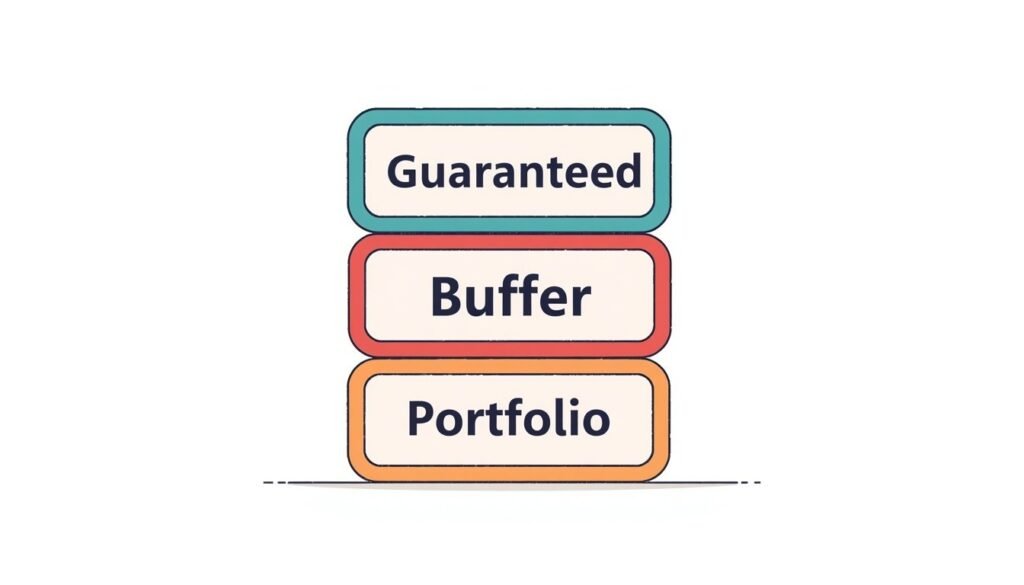
Second, build your income in layers. Stop thinking of retirement income as one big pile of money. The first tier is guaranteed: Social Security, pension, anything that shows up regardless of what the market does. That’s your floor. The second tier is semi-passive: dividends, interest income, maybe a small rental or part-time income in early retirement. That’s your buffer. If this layer is generating thirty thousand a year, that’s thirty thousand your portfolio doesn’t need to liquidate. That gives your balance more room to stay intact. The third tier is portfolio withdrawals. That should be the last line you draw from, not the first.
When those three layers are stacked intentionally, a bad market year doesn’t immediately mean you have to sell at a loss. You can pull from tier two while tier three recovers.
Third, think about when you pay taxes. Between the year you retire and the year your required minimum distributions kick in (currently age seventy-three), there’s often a period where your taxable income is lower than it’s been in a long time. No paycheck. Social Security maybe hasn’t started yet. Your portfolio isn’t being drawn down heavily. That window is often when Roth conversions make the most sense.
If you convert fifty thousand from a traditional IRA to a Roth in a year when you’re in the twelve percent bracket, you pay around six thousand in taxes. If you wait and take that same money as a required minimum distribution in a year when you’re in the twenty-two percent bracket, you pay eleven thousand. Same fifty thousand. Five thousand dollar difference. Multiply that across several years and the lifetime tax savings can be significant.
That window doesn’t stay open forever.
Few Questions
What if the market crashes right after I retire?
That’s a real risk. Nobody should pretend otherwise. But that’s exactly why the gap math and the income layers matter. If your guaranteed income and buffer layer cover your basic spending, you don’t have to sell stocks at the bottom. You can wait for the recovery. Sequence of returns risk is real, but it’s manageable if you structure withdrawals intentionally.
Does this work if I don’t have a pension?
Most people don’t have pensions anymore. Social Security becomes your main guaranteed layer. For some people, that might mean delaying Social Security to get a higher monthly benefit. For others, it might mean building a larger buffer layer with dividends or a small annuity. The framework still works. You just adjust which layers are thicker.
How do I know if I’m underspending?
This is harder to answer because it’s personal. But a clue is if you’re constantly saying no to things you actually want to do, and the only reason is fear, not math. If you’ve run the numbers and the gap is small, and you still won’t book the trip or fix the kitchen, that might be underspending. A financial planner can help you stress-test the assumptions.
Should I pay off my mortgage before retiring?
It depends. A mortgage is a fixed expense. Lower fixed expenses mean a smaller gap, which means less risk. But if your mortgage rate is very low, some people prefer to keep it and let their portfolio grow. There’s no universal right answer. Run both scenarios and see which one lets you sleep better.