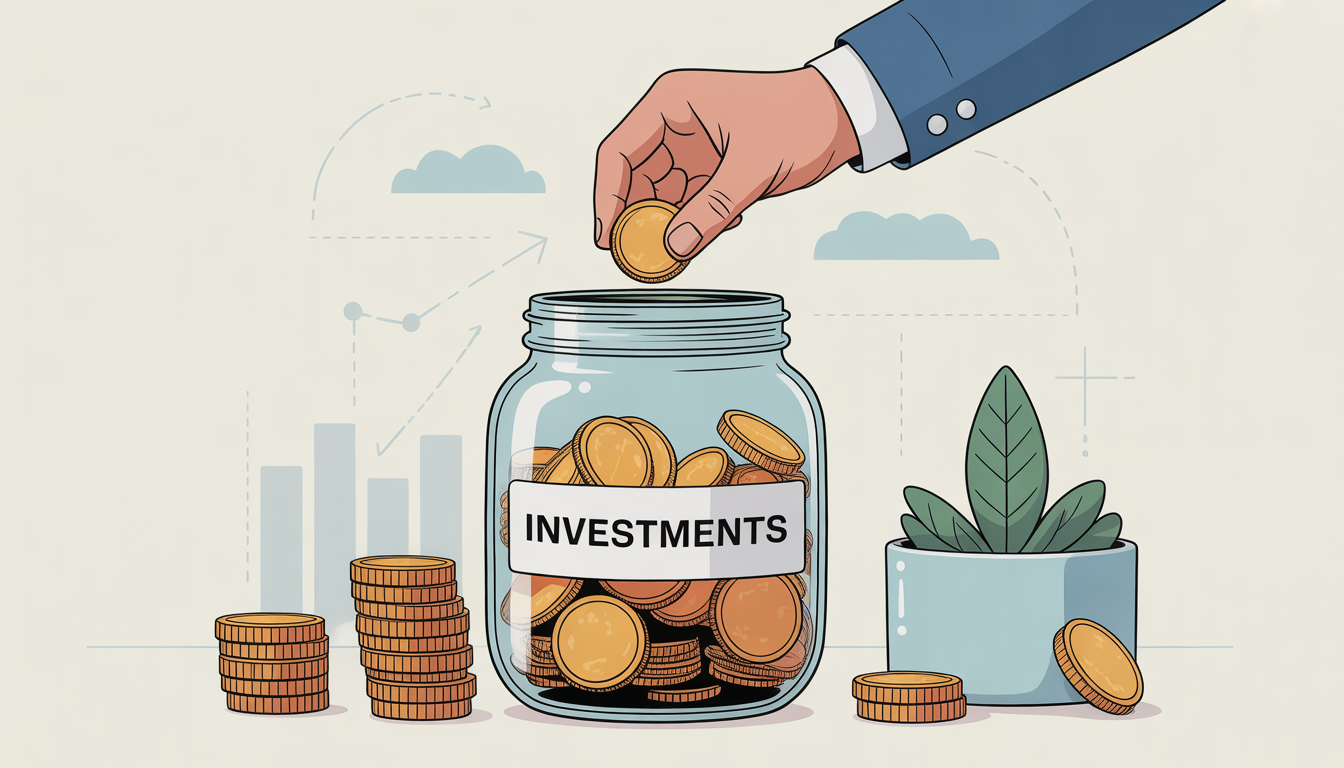
New to investing? Learn what investment accounts are, how they work, and the different types available in the U.S. (401(k), IRA, brokerage). A beginner’s guide to growing your money.
Start with your employer 401(k) if they match contributions. Then open a Roth IRA at Fidelity or Schwab. Then a taxable brokerage account last. Explain why in plain English.
| Account Type | Tax Benefit | 2026 Contribution Limit | Best For |
|---|---|---|---|
| 401(k) | Pre-tax contributions | $23,500 | Employed people with employer match |
| Roth IRA | Tax-free growth | $7,000 | Anyone under income limit (~$161k single) |
| Traditional IRA | Tax deduction now | $7,000 | Higher earners expecting lower retirement tax |
| Taxable Brokerage | None | No limit | Investing beyond retirement accounts |
You’re doing the right thing with your money. You have a budget, you’re saving a little each month, and you’ve stashed away a solid emergency fund. But that cash sitting in your savings account—earning next to nothing—might be leaving you wondering: Is my money working hard enough for me?
If you’ve heard stories about the stock market or people building wealth “passively,” but you feel like you don’t know where to start, you’re in the right place. The gateway to growing your money isn’t just about having cash; it’s about having the right investment account. with insurens
This guide will explain exactly what investment accounts are, how they differ from a regular bank account, the various types available to you in the U.S., and how you can use them to build long-term wealth safely.

What Is an Investment Account? (The Simple Definition)
An investment account is a specialized financial account designed to hold, buy, and sell assets like stocks, bonds, mutual funds, and exchange-traded funds (ETFs) . Unlike a standard savings account at a bank where your money sits and earns a small amount of interest, an investment account is designed to put your money to work in the financial markets. free investment calculator
Think of it this way: a savings account is like a bucket—it holds your cash safely, but it doesn’t grow much. An investment account is like a greenhouse—you put your money (seeds) inside, and over time, with the right conditions, it has the potential to grow into something much larger .
While a savings account offers a guaranteed but usually low interest rate, an investment account offers the potential for higher returns over time, but with the understanding that the value can go up and down .
Why a Standard Savings Account Isn’t Enough for Wealth Building
Before diving into the mechanics, it’s important to understand why investing is a crucial step beyond saving. Right now, inflation is a silent wealth-killer. If inflation is hovering around 3% and your savings account is earning 0.5%, your money is actually losing purchasing power every year .
Investment accounts offer a hedge against inflation. Historically, the stock market has outpaced inflation by a significant margin over long periods . This doesn’t mean you shouldn’t save cash (emergency funds are vital!), but it means that for long-term goals like retirement or a child’s college fund, you need the growth potential that only investing can provide.
How Do Investment Accounts Work?
At its core, an investment account acts as a bridge between you and the financial markets. Here is the step-by-step process of how they function:
- You Open the Investment Accountst: You choose a financial institution (like Vanguard, Fidelity, or Charles Schwab) and open an account .
- You Fund It: You transfer money from your regular bank account into the investment account. This is usually done via an electronic transfer .
- You Make Choices: This is the most important step. You decide what to buy with that money. Common options include:
- Stocks: Buying a tiny piece of a company (like Apple or Coca-Cola) .
- Bonds: Loaning your money to a company or the government in exchange for interest payments .
- Mutual Funds/ETFs: Buying a basket of many different stocks or bonds at once, which provides instant diversification .
- Your Money Grows (or Declines): The value of your investments will fluctuate based on the market. You can make money in two main ways:
- Appreciation: The price of the stock or fund you bought goes up .
- Income: The investments pay you dividends or interest, which you can either take as cash or reinvest to buy more shares .
- The Magic of Compounding: As you earn returns, that money starts earning its own returns. Over 10, 20, or 30 years, compounding can turn small, regular contributions into a substantial nest egg .
Types of Investment Accounts: Choosing the Right Vehicle
In the United States, not all investment accounts are created equal. They generally fall into two main categories: tax-advantaged and taxable. Choosing the right one depends entirely on your financial goal.

Tax-Advantaged Accounts (For Retirement and Specific Goals)
These accounts offer tax breaks to encourage saving for specific purposes, usually retirement or education.
- Employer-Sponsored Retirement Plans (401(k), 403(b)): This is often the first account people encounter. Money is taken directly from your paycheck before taxes are withheld (traditional), which lowers your taxable income now. Many employers also offer a “match”—essentially free money added to your account . There is a Roth 401(k) option where you pay taxes now and withdraw tax-free later .
- Traditional IRA (Individual Retirement Account): Anyone with earned income can open one. You contribute pre-tax dollars (which may be tax-deductible), the money grows tax-deferred, and you pay income tax on withdrawals in retirement .
- Roth IRA: This is a favorite among younger investors. You contribute after-tax dollars, meaning you don’t get a tax break today. However, if you follow the rules, your money grows tax-free, and you pay $0 in taxes when you withdraw it in retirement . There are income limits for contributing directly to a Roth IRA.
- 529 College Savings Plan: Designed specifically for education expenses. You contribute after-tax dollars, but the money grows tax-free, and withdrawals for qualified education costs (tuition, books, room and board) are also tax-free .
- Health Savings Account (HSA): Often called the “triple tax-advantaged” account. If you have a high-deductible health plan (HDHP), you can contribute pre-tax dollars, the money grows tax-free, and withdrawals for qualified medical expenses are tax-free .
Taxable Accounts (For Flexibility)
- Brokerage Account: This is the standard, flexible account. You can contribute as much as you want, whenever you want, and withdraw money at any time for any reason without penalty . The trade-off? You have to pay taxes on the dividends, interest, and capital gains (profits) in the year you receive or realize them . This is the best account for goals that are more than 5 years away but before retirement, like buying a vacation home or starting a business.
| Account Type | Primary Goal | Tax Treatment | Contribution Limits (2025 est.) |
|---|---|---|---|
| 401(k) | Retirement | Pre-tax or Roth | $23,500 (plus $7,500 catch-up) |
| Roth IRA | Retirement | After-tax (tax-free growth) | $7,000 (plus $1,000 catch-up) |
| Traditional IRA | Retirement | Pre-tax (tax-deferred growth) | $7,000 (plus $1,000 catch-up) |
| Brokerage Account | General Investing | Taxable (Capital Gains) | None |
| 529 Plan | Education | After-tax (tax-free for expenses) | Varies by State (often high limits) |
| HSA | Medical Expenses | Pre-tax (triple tax-advantage) | $4,300 (Self) / $8,650 (Family) |
Contribution limits are set by the IRS and typically increase slightly each year .
How to Start: A Beginner’s Roadmap
Opening an investment account is often a 15-minute process, but the preparation is what counts.
Step 1: Check Your Foundation.
Before you invest, ensure you have a stable emergency fund (3-6 months of expenses) in a regular bank account and are managing high-interest debt . Investing is a long-term game, and you don’t want to be forced to sell stocks at a loss because of an unexpected car repair.
Step 2: Define Your Goal and Time Horizon.
Ask yourself: What is this money for?
- Retirement in 30 years? Look at a Roth IRA or 401(k).
- A down payment on a house in 7 years? A standard brokerage account might be best.
- My newborn’s college tuition? A 529 plan is the obvious choice .
Step 3: Open and Fund the Account.
Choose a reputable brokerage firm. You will need your Social Security number, address, and employment information. You’ll also link your bank account to transfer funds .
Step 4: Choose Your Investment (Start Simple!).
This is where beginners get overwhelmed. You don’t need to pick individual stocks. A fantastic starting point for beginners is a Target Date Fund or a broad Index Fund (like one that tracks the S&P 500). These are pre-built collections of stocks that give you instant diversification .
Step 5: Automate and Ignore the Noise.
Set up automatic monthly transfers. This strategy, known as dollar-cost averaging, takes the emotion out of investing . You buy more shares when prices are low and fewer when prices are high. Then, resist the urge to check your balance every day.

Understanding the Risks (Don’t Skip This)
Investing involves risk, including the potential loss of principal. It is essential to go in with your eyes open.
- Market Volatility: Prices go up and down. Sometimes, they go down a lot. This is normal .
- Time Horizon Risk: The biggest risk for beginners is needing the money too soon. If you invest money you’ll need in 2 years, and the market drops, you’ll be forced to sell at a loss. That’s why stocks are for long-term goals (5+ years) .
- Inflation Risk: This is the risk that your money doesn’t grow enough to keep up with rising prices—exactly the risk of keeping too much cash.
5 Common Beginner Mistakes (And How to Avoid Them)
Avoiding these pitfalls is just as important as choosing the right account.
- Trying to Time the Market: Jumping in and out, trying to buy low and sell high. Studies show that most market timers underperform those who simply stay invested . Fix: Time in the market beats timing the market.
- Letting Emotions Drive Decisions: Panic-selling when the market drops locks in your losses . Fix: Remember your long-term goal and stick to your plan.
- Putting All Your Eggs in One Basket: Buying stock in just one company you like is incredibly risky . Fix: Diversify. Buy funds that hold hundreds of different companies.
- Ignoring Fees: High account fees or fund expense ratios eat away at your returns over decades . Fix: Look for low-cost brokers and index funds with expense ratios under 0.10%.
- Not Updating Beneficiaries: Forgetting to name (or update) who gets the account if something happens to you . Fix: Review your beneficiary designations after major life events like marriage or having a child.
The Long-Term View: Consistency is Key
Building wealth isn’t about finding a magic stock tip. It’s about opening the right account, choosing a simple diversified investment, and contributing consistently for years.
Imagine two friends:
- Alex starts investing $200 a month in a Roth IRA at age 25.
- Bailey waits until age 35 to start investing $400 a month.
Even though Bailey invests twice as much per month, Alex will likely have significantly more money by age 65 because their money had an extra decade to compound and grow. Starting early, even with small amounts, is the ultimate superpower .
Frequently Asked Questions
How much money do I need to open an investment account?
You don’t need a lot. Many brokers like Fidelity and Charles Schwab have $0 account minimums and allow you to buy fractional shares of ETFs, meaning you can start with as little as $5 or $10 .
What is the difference between a Traditional IRA and a Roth IRA?
It’s about when you pay taxes. With a Traditional IRA, you get a tax break now (lowering your taxable income), but you pay taxes on withdrawals in retirement. With a Roth IRA, you pay taxes on the money now, but all future growth and withdrawals are tax-free .
Can I lose all my money in an investment account?
While the value of your investments can certainly drop, if you are well-diversified (e.g., owning a broad S&P 500 index fund), it is highly unlikely you will lose all your money. The entire U.S. stock market has never gone to zero. However, if you invest all your money in a single speculative stock, you absolutely could lose your entire investment .
Are investment accounts FDIC insured?
Generally, no. FDIC insurance protects cash in bank accounts. Investment accounts hold securities (stocks, bonds, funds). They are protected by SIPC (Securities Investor Protection Corporation), which protects you if the brokerage firm fails, but it does not protect you from losses due to market declines .
An investment account is simply the tool that allows your money to grow beyond the limits of a savings account. Whether you choose a Roth IRA for retirement, a 529 for education, or a standard brokerage account for flexibility, the most important step is to start.
You don’t need to be a Wall Street expert. You just need a plan, a little patience, and the discipline to keep contributing through the ups and downs. Your future self will thank you.
Disclaimer: This article is for educational and informational purposes only and does not constitute financial advice. Please consult with a qualified financial professional regarding your specific financial situation.
Table of Contents
ADHD Budget Planner App | Debt Tracker, Bill Organizer (Digital Download)
Debt Payoff Tracker 💳 Debt Payoff Tracker Auto-savedFREE DEMO ⭐ Instructions 💳 My Debts 📊 Dashboard ❄️ Snowball Plan 🏔️ Avalanche Plan 📅 Payment Log 🎯 Debt-Free Countdown 🔒 This is a FREE DEMO — you can add up to 2 debts to test it out. Get the full version for unlimited debts, saved data,…
Free Debt Payoff Tracker — Try the Snowball & Avalanche Calculator
Paying off debt feels overwhelming when you don’t know where to start, which balance to attack first, or how much interest you’re really losing each month. That’s exactly why we built the Debt Payoff Tracker — a simple, visual tool that turns your credit cards, loans, and balances into a clear, step-by-step payoff plan. Instead…

Free Vehicle Bill of Sale Template & Generator | Fillable PDF
What Is a Vehicle Bill of Sale Template? A vehicle bill of sale is a document that records the private sale of a car, truck, SUV, motorcycle, ATV, UTV, van, RV, boat, or trailer. It confirms who bought and sold the vehicle, the price paid, the vehicle’s condition, and any disclosures both parties agreed to…

Best Brokerage for Beginners: Top 5 Picks for 2026
I remember staring at my bank balance about eight years ago, convinced I didn’t have “enough” money to start investing. I thought you needed thousands of dollars, a Wall Street connection, and maybe a fancy calculator just to get in the door. So I just… didn’t do anything. I let that money sit in a…
Stock Profit Calculator USA Capital Gains & Commission Tool
📊 Stock Profit Calculator USA 📈 Number of shares 💰 Buy price ($) 💸 Sell price ($) 🛒 Buy commission ($) 🏷️ Sell commission ($) 🏛️ Tax rate (%) 0% (No tax)15% (Long-term)20% (High income)37% (Short-term) 💰 Calculate My Profit Net Buy Cost: $0 Net Sell Proceeds: $0 Profit Before Tax: $0 Tax Amount: $0…
IUL vs Roth IRA vs 401k | Honest Take for Beginners
Here’s the thing nobody tells you when you first start hearing about retirement accounts: there are about a million ways to save for the future, and half of them come with acronyms that sound like government surveillance programs. IUL vs Roth IRA vs 401k free investment return calculator If you’ve ever stared at a benefits…
7 Best Side Hustles for Beginners in 2026
Let me be real with you for a second. Most “side hustle” articles you’ll find online were written by someone who’s never actually done any of them. They list the same seven things, slap some numbers on it, and call it a day. You read it, feel motivated for about eleven minutes, and then do…
Side Hustles for Nurses in 2026: 9 Real Ways to Earn Extra Income
why Start Side Hustles for Nurses Long shifts. Emotional exhaustion. The physical toll. And yet, depending on where you live in the U.S.—say, a coastal city or even a growing spot like Nashville or Austin—that paycheck might vanish faster than a turkey sandwich on a 12-hour night shift. How Much Can Nurses Realistically Earn From…
The Retirement Spending Gap (Real Math)
I used to think retirement was simple math. You save. You stop working. Then you spend what you saved until it runs out. That feels logical, right? Like filling a bathtub and then pulling the drain plug. So Retirement Spending Gap Video is Here But here’s the thing. That’s not what actually happens for a…

I saved $10 per day for 30 days—here’s how much I made
It started as a bet with myself. Not the kind of bet Where you put money on a game or talk yourself into buying something dumb. The boring kind. The kind where you look at your bank account on a random Tuesday and think, surely I can find ten bucks somewhere. So I tried it.…


















Pingback: How the US Stock Market Works Explained Easy 2026