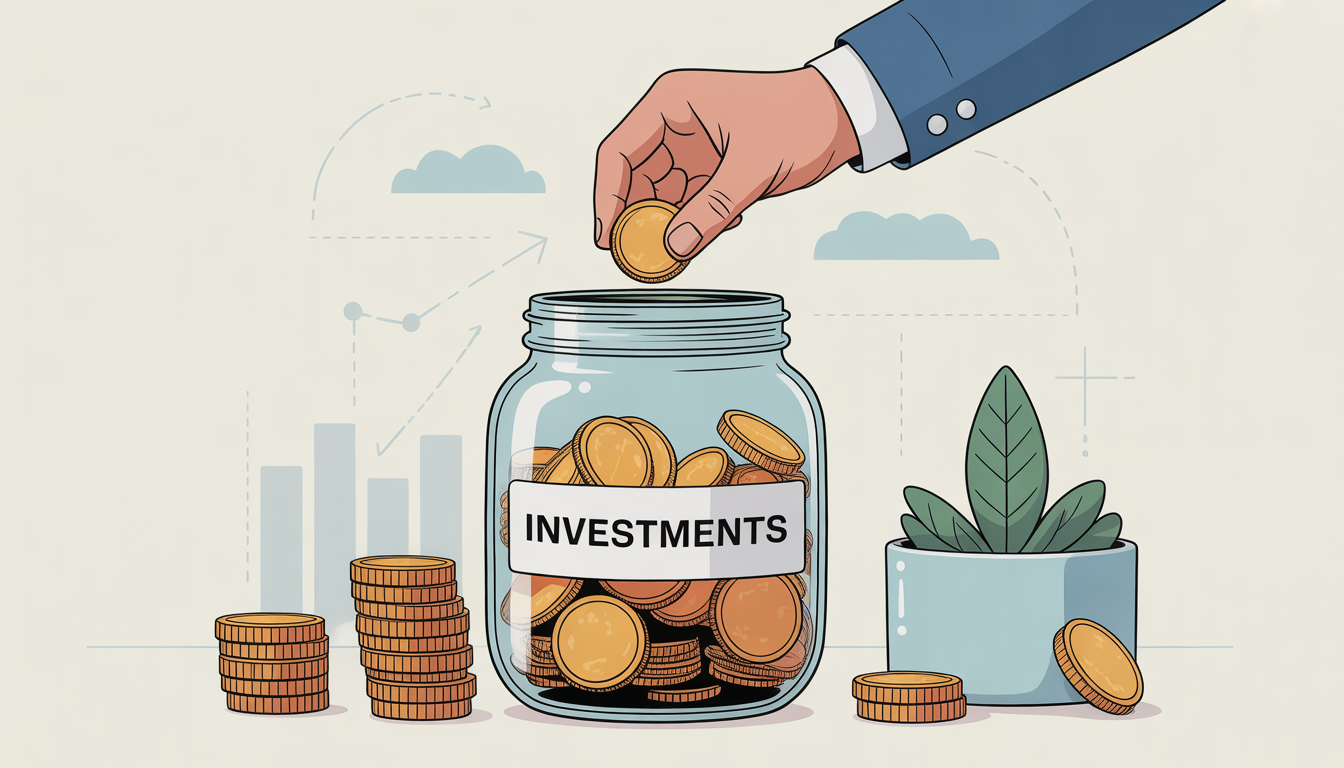
If you’ve ever looked at your bank savings account and wondered if your money could be doing more, you are not alone. Long-Term Investing With the cost of living rising and traditional savings accounts offering minimal interest, many Americans are looking for ways to build genuine financial security.
However, the world of stocks and bonds can feel intimidating. We’ve all seen movies depicting frantic traders screaming on the floor of the stock exchange, or heard stories of people losing money overnight. It’s easy to assume that investing is just a form of gambling.
But there is a significant difference between speculation and long-term investing. While gambling relies on luck, long-term investing relies on time, patience, and the proven ability of the economy to grow. This article will explain exactly how long-term investing builds wealth over time, why it is accessible to beginners, and how you can start with confidence.

What Is Long-Term Investing?
At its core, long-term investing is the strategy of buying and holding assets—such as stocks, bonds, or index funds—for several years or even decades. Unlike “day trading,” where investors try to profit from short-term market fluctuations, long-term investors ignore the daily “noise” of the market to focus on gradual growth.
The goal is not to “get rich quick,” but to build substantial wealth slowly through the power of compounding and general market appreciation. This approach aligns with the financial planning of retirement accounts like 401(k)s and Roth IRAs, which are designed to grow over a working lifetime.
The Core Mechanics: How Wealth is Actually Built with Long-Term Investing
To understand why long-term investing is so effective, you need to understand the two main engines that drive your wealth: Compound Interest and Market Growth. Free investment return calculator
1. The Power of Compounding
Albert Einstein reportedly called compound interest the “eighth wonder of the world.” In simple terms, compounding is when you earn returns not only on your initial investment but also on the returns that investment has already generated.
Let’s look at a simple real-world example:
- If you invest $1,000 and it grows by 10% in the first year, you have $1,100.
- In year two, if you get another 10% return, you don’t just make another $100; you make $110 because you earned 10% on the new total of $1,100.
- Over 20 or 30 years, this snowball effect turns small, consistent contributions into massive sums of money.
2. The Trend of the U.S. Economy
Despite recessions, wars, and crises, the U.S. economy has consistently grown over the long haul. Businesses innovate, become more efficient, and earn more profits. When you own a piece of a business (through a stock) or a basket of businesses (through a fund), you benefit from that growth.
Why “Time in the Market” Beats “Timing the Market”

One of the most common mistakes beginners make is trying to wait for the “perfect” moment to invest. They hope to buy right before a price jump and sell right before a crash. This is called “timing the market,” and it is nearly impossible to do consistently, even for professionals.
Long-term investing eliminates this stress. Instead of trying to predict the future, you rely on time in the market.
Consider this: If you had invested $10,000 in the S&P 500 (a collection of 500 large U.S. companies) 30 years ago and simply held on, you would have weathered major crashes like the Dot-com bubble and the 2008 financial crisis. Yet, your investment would still be worth significantly more today simply because the market trended upward over those three decades.
Key Benefits of a Long-Term Strategy
Adopting a long-term mindset offers advantages that go beyond just the numbers in your portfolio.
- Reduced Stress: You stop checking stock prices every five minutes. You understand that a down week or month is just a blip on a very long radar.
- Lower Taxes: In the U.S., assets held for over one year qualify for long-term capital gains tax, which is generally lower than the short-term rate (what you pay on assets held for less than a year). This keeps more money in your pocket.
- Lower Fees: Frequent trading racks up brokerage commissions and fees. A buy-and-hold strategy minimizes these costs.
- Dividend Growth: Many companies increase their dividends (payments to shareholders) every year. By holding these companies for decades, you can build a significant stream of passive income.
A Practical Guide for Beginners
If you are new to this, the most important step is to start, no matter how small the amount. Here is a simple, safe path to begin your long-term investing journey.
1. Build Your Foundation First
Before investing, ensure you have a solid financial base:
- Pay off high-interest debt (like credit cards).
- Build an emergency fund covering 3–6 months of expenses in a regular savings account.
- If your employer offers a 401(k) match, contribute at least enough to get the full match—it’s free money.
2. Choose the Right “Vehicle”
In the U.S., you generally invest inside specific accounts:
- 401(k): Employer-sponsored. Often comes with a tax break now (Traditional) or tax-free growth later (Roth).
- Roth IRA: An individual account you open yourself. You pay taxes on the money going in, but it grows tax-free, and you pay no taxes when you withdraw in retirement.
3. Decide What to Buy
For beginners, it is rarely wise to pick individual stocks. Instead, look at:
- Index Funds: A collection of stocks that tracks a specific index (like the S&P 500).
- ETFs (Exchange-Traded Funds): Similar to index funds but trade like stocks throughout the day.
These options give you instant diversification—meaning you own tiny pieces of hundreds of companies, which lowers your risk if one company performs poorly.
4. Automate and Ignore
Set up automatic transfers from your bank account to your investment account every month. This is called dollar-cost averaging. It ensures you buy more shares when prices are low and fewer when prices are high, smoothing out your entry point. Then, try to check your portfolio only once or twice a year.
Understanding Risk (And Why It Diminishes Over Time)
It is crucial to understand that investing is not risk-free. In the short term, the stock market is volatile. You could invest $1,000 today, and next month, it might be worth $800 due to market conditions. This scares many beginners into selling, which “locks in” that loss.
However, historical data shows that while the chance of losing money in a single year is relatively high, the chance of losing money over a 10- or 20-year period drops dramatically—approaching zero for a diversified portfolio.
Long-term investing works because it gives your money time to recover from the downs and ride the ups.
5 Common Mistakes Beginners Make

Avoid these pitfalls to stay on track:
- Trying to time the market: Missing just a few of the market’s best days can drastically reduce your lifetime returns.
- Checking your portfolio too often: Watching daily fluctuations can lead to emotional, irrational decisions.
- Investing in what you don’t understand: If you can’t explain where the money comes from, avoid it (especially trendy crypto or meme stocks).
- Following “hot tips”: Advice from social media or a friend at a barbecue is not a sound investment strategy.
- Giving up too soon: The market will go down. The key is to stay invested. Corrections are normal.
The Long-Term Perspective: A Marathon, Not a Sprint
Think of long-term investing like planting an oak tree. You dig a hole, plant a tiny seed, cover it up, and water it. For the first few years, you might see just a small sprout. You don’t dig it up every week to check if the roots are growing—you trust the process.
Years later, that seed becomes a mighty oak that provides shade and shelter. Your investments work the same way. By contributing consistently and leaving your investments alone, you allow the power of the U.S. economy and compound interest to work for you.
Conclusion
Long-term investing is the most reliable path to building wealth for retirement, a home down payment, or financial independence. It doesn’t require a finance degree or a crystal ball. It requires patience, discipline, and consistency.
By starting today—even with a small amount—and focusing on the long horizon, you are taking the most important step toward securing your financial future. Remember, the goal is not to beat the market today, but to participate in its growth over a lifetime.
Frequently Asked Questions (FAQ)
1. How much money do I need to start long-term investing?
You don’t need a lot of money to start. Many brokerage apps and platforms allow you to buy fractional shares of ETFs or index funds for as little as $5 or $10. The habit of investing regularly is more important than the initial dollar amount.
2. Is it safe to invest during a recession?
While it feels counterintuitive, investing during a recession can be a powerful move because assets are often “on sale.” If you are investing for the long term (10+ years), buying during a downturn means you are acquiring shares at lower prices, which can lead to higher gains when the market eventually recovers.
3. What is the difference between a Traditional 401(k) and a Roth IRA?
The main difference is tax treatment. Long-Term Investing
- A Traditional 401(k) lets you contribute pre-tax dollars, lowering your taxable income now, but you pay income tax on the money when you withdraw it in retirement.
- A Roth IRA uses after-tax dollars, so you pay taxes now, but the money grows tax-free, and you pay no taxes on qualified withdrawals in retirement.
4. What happens if the stock market crashes?
If the market crashes and you are a long-term investor, ideally, you do nothing—or you continue investing. Historically, every major market crash has been followed by a recovery. Selling in a panic turns a temporary loss into a permanent one. Staying invested allows you to recover and benefit from the eventual rebound.
Table of Contents
ADHD Budget Planner App | Debt Tracker, Bill Organizer (Digital Download)
Debt Payoff Tracker 💳 Debt Payoff Tracker Auto-savedFREE DEMO ⭐ Instructions 💳 My Debts 📊 Dashboard ❄️ Snowball Plan 🏔️ Avalanche Plan 📅 Payment Log 🎯 Debt-Free Countdown 🔒 This is a FREE DEMO — you can add up to 2 debts to test it out. Get the full version for unlimited debts, saved data,…
Free Debt Payoff Tracker — Try the Snowball & Avalanche Calculator
Paying off debt feels overwhelming when you don’t know where to start, which balance to attack first, or how much interest you’re really losing each month. That’s exactly why we built the Debt Payoff Tracker — a simple, visual tool that turns your credit cards, loans, and balances into a clear, step-by-step payoff plan. Instead…

Free Vehicle Bill of Sale Template & Generator | Fillable PDF
What Is a Vehicle Bill of Sale Template? A vehicle bill of sale is a document that records the private sale of a car, truck, SUV, motorcycle, ATV, UTV, van, RV, boat, or trailer. It confirms who bought and sold the vehicle, the price paid, the vehicle’s condition, and any disclosures both parties agreed to…

Best Brokerage for Beginners: Top 5 Picks for 2026
I remember staring at my bank balance about eight years ago, convinced I didn’t have “enough” money to start investing. I thought you needed thousands of dollars, a Wall Street connection, and maybe a fancy calculator just to get in the door. So I just… didn’t do anything. I let that money sit in a…
Stock Profit Calculator USA Capital Gains & Commission Tool
📊 Stock Profit Calculator USA 📈 Number of shares 💰 Buy price ($) 💸 Sell price ($) 🛒 Buy commission ($) 🏷️ Sell commission ($) 🏛️ Tax rate (%) 0% (No tax)15% (Long-term)20% (High income)37% (Short-term) 💰 Calculate My Profit Net Buy Cost: $0 Net Sell Proceeds: $0 Profit Before Tax: $0 Tax Amount: $0…
IUL vs Roth IRA vs 401k | Honest Take for Beginners
Here’s the thing nobody tells you when you first start hearing about retirement accounts: there are about a million ways to save for the future, and half of them come with acronyms that sound like government surveillance programs. IUL vs Roth IRA vs 401k free investment return calculator If you’ve ever stared at a benefits…
7 Best Side Hustles for Beginners in 2026
Let me be real with you for a second. Most “side hustle” articles you’ll find online were written by someone who’s never actually done any of them. They list the same seven things, slap some numbers on it, and call it a day. You read it, feel motivated for about eleven minutes, and then do…
Side Hustles for Nurses in 2026: 9 Real Ways to Earn Extra Income
why Start Side Hustles for Nurses Long shifts. Emotional exhaustion. The physical toll. And yet, depending on where you live in the U.S.—say, a coastal city or even a growing spot like Nashville or Austin—that paycheck might vanish faster than a turkey sandwich on a 12-hour night shift. How Much Can Nurses Realistically Earn From…
The Retirement Spending Gap (Real Math)
I used to think retirement was simple math. You save. You stop working. Then you spend what you saved until it runs out. That feels logical, right? Like filling a bathtub and then pulling the drain plug. So Retirement Spending Gap Video is Here But here’s the thing. That’s not what actually happens for a…

I saved $10 per day for 30 days—here’s how much I made
It started as a bet with myself. Not the kind of bet Where you put money on a game or talk yourself into buying something dumb. The boring kind. The kind where you look at your bank account on a random Tuesday and think, surely I can find ten bucks somewhere. So I tried it.…

















Pingback: Investment Accounts Explained: A Beginner's Guide 2026