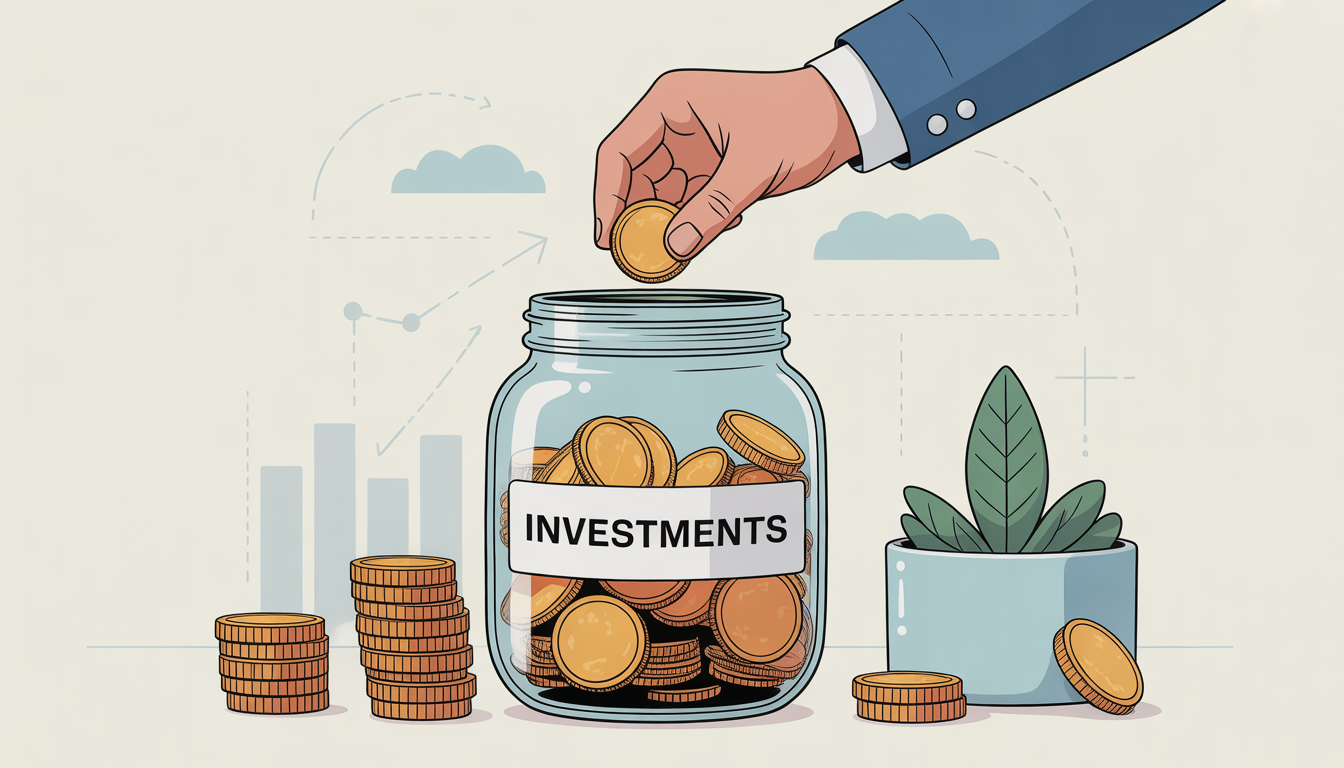
Start Investing in the US You’ve finally paid off a chunk of credit card debt, you’ve got a small cushion in your savings account, and you’re ready to take the next step toward financial freedom. But every time you think about Start Investing in the US, a nagging question stops you cold: “Isn’t that for people with a lot of money?” Start Investing in the US?
You picture Wall Street traders, luxury cars, and people throwing around terms like “IPO” and “dividends.” It feels like an exclusive club with a high cover charge.
If this sounds familiar, you’re not alone. The biggest myth in personal finance is that you need a pile of cash to start building wealth. The reality, especially for beginners in the United States, is far more accessible.

So, how much money do you actually need to Start Investing in the US?
The short answer is: You can start investing in the US. stock market with as little as $1 to $100.
In this guide, we’ll break down exactly where to start, how to do it safely, and the mindset you need to turn small amounts of money into long-term wealth.
What Does It Mean to Start Investing in the US?
Before we look at dollar amounts, let’s define the term. For a complete beginner, investing means purchasing assets (like stocks, bonds, or index funds) with the goal of growing your money over time, rather than letting it lose value to inflation in a regular savings account.
Unlike gambling, investing is not about getting rich by next Friday. It is a systematic approach to building wealth by owning a small piece of a company (stocks) or a diversified basket of companies (funds).
When you invest in the US stock market, you are essentially betting on the growth of the American economy. Historically, the market has trended upward over long periods, despite short-term ups and downs. Start Investing in the US
The Good News: The Barriers Have Disappeared

Twenty years ago, buying stocks was expensive. You had to go through a human broker, and you might pay $20 to $50 in fees for a single trade. If you only had $100, half of it would be gone before you even bought anything.
Today, thanks to financial technology (fintech) and regulatory changes, the game has changed completely for the US investor. The two biggest barriers—fees and minimum deposits—have mostly vanished.
This means you can now invest small amounts of money without being penalized.
How Much Do You Really Need? Breaking Down the Numbers
Let’s look at the different entry points depending on where you choose to invest.
1. The “Zero-Dollar” Entry (Start Investing in the US)
Many popular brokerage apps now allow you to open an account with $0.
- Fractional Shares: This is the biggest game-changer. Instead of needing $500 to buy one share of a popular company like Amazon or Nvidia, you can buy a “fractional share.” You can invest just $5 or $10 and own a tiny piece of that stock.
- How it works: You decide you want to invest $20 in the S&P 500. The brokerage divides the cost of the ETF (Exchange Traded Fund) and credits you with a portion of a share.
2. The “Latte” Entry ($5 – $50 per month) Start Investing in the US
You don’t need a lump sum. You need consistency. Most modern apps allow you to set up recurring transfers.
- Example: If you invest $25 a week (roughly the cost of a few takeout coffees), that’s $1,300 a year. Over 30 years, with compound interest, that small habit can grow into a significant nest egg.
3. The “Starter” Entry ($100 – $500)
If you have a little more saved up, you can look at Index Funds or ETFs.
- These are “baskets” of stocks that track the market (like the S&P 500).
- While some mutual funds have high minimums ($1,000+), many brokerages now offer their own index funds with minimums as low as $1 (like Fidelity’s FNILX) or Vanguard’s ETFs which you can buy a single share of for a few hundred dollars.
Where Should a Beginner Invest Their First $50?

If you have $50 burning a hole in your pocket and you want to put it to work, here is the logical path you should take (without me recommending a specific stock):
- Choose a Brokerage: Look for a reputable platform that is a member of SIPC (Securities Investor Protection Corporation). This protects you up to $500,000 if the brokerage fails.
- Look for “Fractional Shares”: Make sure the app or website allows you to buy slices of stocks or ETFs.
- Consider a “Roth IRA”: If you want to invest for retirement (age 59+), a Roth IRA is a powerful tool. You contribute money you’ve already paid taxes on (after-tax dollars), and it grows tax-free. You can often open a Roth IRA with $0, but you need money to fund it.
- Buy a Broad Market ETF: For your first investment, consider an ETF that tracks the S&P 500. This gives you exposure to 500 of the largest companies in the US. You are betting on America, not just one risky company.
The Financial Checklist: Before You Invest
Before you send that first dollar to the stock market, let’s do a quick safety check. Investing always carries risk, and you want to make sure you are financially stable enough to handle the market’s ups and downs.
Do not invest money you will need in the next 3-5 years. Start Investing in the US
The Pre-Investment Checklist (U.S. Edition):
- High-Interest Debt: Do you have credit card debt with a 20%+ APR? Pay that off first. Paying off debt is a guaranteed “return” on your money, whereas the stock market is not.
- Emergency Fund: Do you have 3-6 months of living expenses saved in a regular bank account (high-yield savings account recommended)? This is your safety net so you don’t have to sell your investments at a loss if your car breaks down.
- Employer 401(k) Match: Does your job offer a 401(k) match? If they match 100% of your contributions up to 3% of your salary, that is free money. Contribute at least enough to get the full match before investing elsewhere.
Understanding Risk: Protecting Your Capital Start Investing in the US
As a new investor, your biggest advantage is time, but your biggest risk is emotion.
- Market Volatility: The stock market goes up and down. In 2020 and 2022, we saw sharp drops. If you invest $100 and the market drops 20%, you now have $80. You haven’t lost money unless you sell. If you hold on, the market historically recovers.
- Inflation Risk: By NOT investing, you are losing purchasing power. If inflation is at 3% and your savings account pays 0.5%, your money is slowly shrinking.
- Speculation vs. Investing: Buying a “meme stock” because it’s trending on social media is speculation (gambling). Buying a broad index fund because you believe in the long-term growth of the US economy is investing.
NJ4 Common Mistakes Beginners Make (And How to Avoid Them) Start Investing in the US see videos on YouTube channel
Starting small is smart, but starting blind is dangerous. Here are the pitfalls to watch out for:
- Trying to Time the Market: Waiting for the “perfect” moment to buy. The best time to invest was yesterday; the second-best time is today. Dollar-cost averaging (investing a fixed amount regularly) removes the stress of timing.
- Checking the App Every Hour: If you invest $50, watching it fluctuate by $2 every day will drive you crazy. The stock market is a long-term game. Check your statements quarterly, not hourly. Start Investing
- Chasing “Hot Tips”: Ignore the stock tips from your cousin or the influencer on TikTok. They are often too late, or they are being paid to promote a stock that might be a scam (pump and dump).
- Forgetting about Taxes: If you invest in a regular taxable brokerage account and sell a stock for a profit, you will owe capital gains tax. If you hold the stock for more than a year, it’s taxed at a lower rate (long-term capital gains). If you use a retirement account like a 401(k) or Roth IRA, you can avoid or defer these taxes.
The Long-Term View: Why Time Beats Money
The most important factor in investing is not the amount you start with, but how long you let it grow. This is the power of compound interest.
Imagine two friends, Alex and Taylor.
- Alex starts investing at age 25, investing $100 a month until age 35, then stops (total invested: $12,000).
- Taylor waits until age 35 and invests $100 a month until age 65 (total invested: $36,000).
Assuming an 8% average annual return, by age 65, Alex would have more money than Taylor simply because Alex started 10 years earlier.
The moral: Starting today with $20 is more powerful than starting next year with $200.
Conclusion: The Best Time to Start is Now Start Investing in the US

You do not need thousands of dollars to become an investor. In 2024 and beyond, the U.S. financial system is more accessible than ever. The barrier is no longer money; it is knowledge and confidence.
Start by getting financially stable—clear your high-interest debt and save a small emergency fund. Then, open a brokerage account, and commit to investing a small amount consistently.
Whether it’s $5 or $500, the act of starting is what matters most. Focus on owning a piece of the broad market (like the S&P 500), reinvest your dividends, and give your money decades to grow. You are not just buying stocks; you are buying your future freedom.
Frequently Asked Questions (FAQ) insurance
1. Is $100 enough to start investing in stocks?
Yes, absolutely. With the advent of fractional share investing, $100 is more than enough. You can use that $100 to buy a fractional share of a high-priced stock or buy several shares of a low-cost ETF (Exchange Traded Fund) that tracks the entire market. Many apps have no minimum deposit, so you can start with the click of a button.
2. Can I lose more money than I invest?
No. If you buy a stock (not on margin, which is borrowing money to trade), the worst-case scenario is that the company goes bankrupt and your stock becomes worthless. You will lose your initial investment, but you will not owe additional money. This is different from short-selling or trading options, which beginners should avoid.
3. What is the difference between a Roth IRA and a regular brokerage account?
A regular (taxable) brokerage account offers flexibility. You can deposit and withdraw money at any time, but you will pay capital gains tax on any profits when you sell.
A Roth IRA is a retirement account. You contribute after-tax dollars, and if you follow the rules (keeping the money in until age 59½), all your withdrawals in retirement are completely tax-free. However, you generally cannot withdraw the growth portion of the money early without a penalty. It’s the best tool for long-term retirement savings.
4. How do I actually buy my first share?
First, open an account with a reputable, low-cost brokerage (like Vanguard, Fidelity, Charles Schwab, or a popular app). Link your U.S. bank account to transfer funds (this is called ACH transfer). Once the money is in your account, search for the company or ETF you want to buy (e.g., “VOO” for the S&P 500). Click “Buy,” enter the dollar amount or number of shares, and confirm the trade. It usually takes just a few seconds.
Table of Contents
ADHD Budget Planner App | Debt Tracker, Bill Organizer (Digital Download)
Debt Payoff Tracker 💳 Debt Payoff Tracker Auto-savedFREE DEMO ⭐ Instructions 💳 My Debts 📊 Dashboard ❄️ Snowball Plan 🏔️ Avalanche Plan 📅 Payment Log 🎯 Debt-Free Countdown 🔒 This is a FREE DEMO — you can add up to 2 debts to test it out. Get the full version for unlimited debts, saved data,…
Free Debt Payoff Tracker — Try the Snowball & Avalanche Calculator
Paying off debt feels overwhelming when you don’t know where to start, which balance to attack first, or how much interest you’re really losing each month. That’s exactly why we built the Debt Payoff Tracker — a simple, visual tool that turns your credit cards, loans, and balances into a clear, step-by-step payoff plan. Instead…

Free Vehicle Bill of Sale Template & Generator | Fillable PDF
What Is a Vehicle Bill of Sale Template? A vehicle bill of sale is a document that records the private sale of a car, truck, SUV, motorcycle, ATV, UTV, van, RV, boat, or trailer. It confirms who bought and sold the vehicle, the price paid, the vehicle’s condition, and any disclosures both parties agreed to…

Best Brokerage for Beginners: Top 5 Picks for 2026
I remember staring at my bank balance about eight years ago, convinced I didn’t have “enough” money to start investing. I thought you needed thousands of dollars, a Wall Street connection, and maybe a fancy calculator just to get in the door. So I just… didn’t do anything. I let that money sit in a…
Stock Profit Calculator USA Capital Gains & Commission Tool
📊 Stock Profit Calculator USA 📈 Number of shares 💰 Buy price ($) 💸 Sell price ($) 🛒 Buy commission ($) 🏷️ Sell commission ($) 🏛️ Tax rate (%) 0% (No tax)15% (Long-term)20% (High income)37% (Short-term) 💰 Calculate My Profit Net Buy Cost: $0 Net Sell Proceeds: $0 Profit Before Tax: $0 Tax Amount: $0…
IUL vs Roth IRA vs 401k | Honest Take for Beginners
Here’s the thing nobody tells you when you first start hearing about retirement accounts: there are about a million ways to save for the future, and half of them come with acronyms that sound like government surveillance programs. IUL vs Roth IRA vs 401k free investment return calculator If you’ve ever stared at a benefits…
7 Best Side Hustles for Beginners in 2026
Let me be real with you for a second. Most “side hustle” articles you’ll find online were written by someone who’s never actually done any of them. They list the same seven things, slap some numbers on it, and call it a day. You read it, feel motivated for about eleven minutes, and then do…
Side Hustles for Nurses in 2026: 9 Real Ways to Earn Extra Income
why Start Side Hustles for Nurses Long shifts. Emotional exhaustion. The physical toll. And yet, depending on where you live in the U.S.—say, a coastal city or even a growing spot like Nashville or Austin—that paycheck might vanish faster than a turkey sandwich on a 12-hour night shift. How Much Can Nurses Realistically Earn From…
The Retirement Spending Gap (Real Math)
I used to think retirement was simple math. You save. You stop working. Then you spend what you saved until it runs out. That feels logical, right? Like filling a bathtub and then pulling the drain plug. So Retirement Spending Gap Video is Here But here’s the thing. That’s not what actually happens for a…

I saved $10 per day for 30 days—here’s how much I made
It started as a bet with myself. Not the kind of bet Where you put money on a game or talk yourself into buying something dumb. The boring kind. The kind where you look at your bank account on a random Tuesday and think, surely I can find ten bucks somewhere. So I tried it.…















Pingback: What Is a Collective Investment Trust? 401(k) Guide 2026
Pingback: Why IUL Is a Bad Investment (Hidden Fees & Risks) 2026